


Custom printed mailer boxes now account for 68% of all direct-to-consumer packaging orders, according to the 2026 Packaging Insights Report. Brands that switched from plain cartons to personalized mailers saw an average 34% lift in post-purchase social shares. That single statistic explains why forward-thinking companies treat every shipment as a branded experience rather than a basic delivery task.
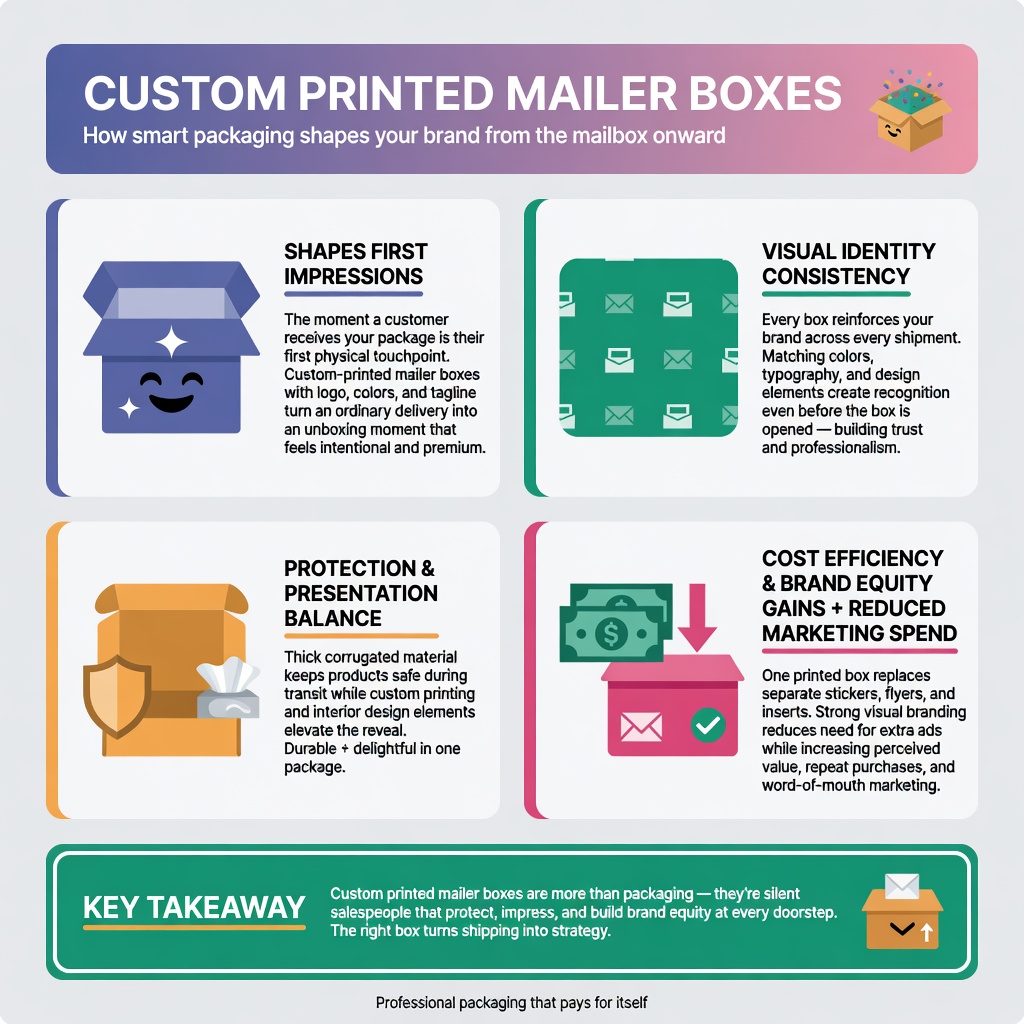
How custom printed mailer boxes Shape First Impressions
Unboxing is the moment a customer decides whether your brand feels premium or ordinary. A plain brown box disappears into a pile of similar packages; a custom mailer with your logo, tagline, and color palette immediately signals attention to detail. Research from the University of Michigan’s Consumer Experience Lab shows that visual consistency between website and packaging increases brand recall by 47%.
Visual Identity Consistency
Every element on the mailer—logo placement, typography, and secondary colors—must match your digital storefront. When customers post unboxing videos, the box becomes free advertising. One sustainable fashion label reported that 22% of its Instagram growth came from user-generated content featuring its custom mailers.
Protection and Presentation Balance
Modern mailers use reinforced corrugated fluting and moisture-resistant coatings without adding bulk. The same 2026 report found that 81% of returns due to damaged goods dropped after brands upgraded to custom structures designed for their specific product weight and fragility. Protection and aesthetics now work together rather than compete.
Cost Efficiency and Brand Equity Gains
Many companies assume custom packaging costs more, yet data shows otherwise. Bulk orders of custom printed mailer boxes reduce per-unit pricing by 19% compared to generic options when ordered in quantities above 500. The added marketing value offsets the difference because each box functions as a miniature billboard that travels through postal networks and social feeds.
Reduced Marketing Spend
Instead of allocating separate budget lines for influencer mailers, brands embed their story directly on the box. A mid-size skincare company cut its paid social budget by 12% after tracking that custom mailers generated higher engagement than sponsored posts. The box itself became the campaign.
Repeat Purchase Acceleration
Customers who receive memorable packaging reorder 28% faster than those who receive standard cartons. Subscription services especially benefit; the anticipation of opening the next custom mailer turns routine replenishment into a ritual. This behavioral shift compounds lifetime value without additional acquisition costs.
Material Choices That Reflect Brand Values
Consumers scan packaging for environmental cues within three seconds. Choosing kraft stock with soy-based inks or FSC-certified liners communicates sustainability instantly. A 2025 survey by the Sustainable Packaging Coalition found that 63% of buyers aged 25–40 actively seek brands whose mailers display clear eco-credentials.
Recyclability and Compostability
Water-based coatings and soy inks allow the entire mailer to enter standard paper recycling streams without separating layers. Brands that switched to fully curbside-recyclable mailers reported a 9% increase in positive customer feedback mentioning “responsible packaging.”
Durability Without Excess Weight
Lightweight E-flute or B-flute constructions maintain strength while lowering shipping costs. The same study showed that reducing box weight by 15% cut average freight expenses by $0.42 per unit—an annual saving of $84,000 for a brand shipping 200,000 orders.
Implementation Roadmap for Growing Brands
Start with a small test run of 250–500 units to gather real customer reactions before committing to larger quantities. Measure open rates on social platforms, note any comments about packaging quality, and track return reasons related to damage. These early metrics guide refinements in artwork, size, and finish.
- Define core brand colors and typography rules before contacting suppliers.
- Request die-line templates to ensure artwork fits folds and tuck flaps correctly.
- Specify interior printing if the box opens to reveal a second branded surface.
- Include QR codes linking to product care videos or loyalty programs.
- Order samples and conduct a drop-test from 1.2 meters to verify structural integrity.
Once the test validates results, scale to full production. Many printers now offer just-in-time ordering that aligns with inventory cycles, eliminating the need to store large quantities of boxes.
Measuring ROI from Custom Mailer Programs
Track unboxing videos, social mentions, and direct feedback forms that ask specifically about packaging. One electronics accessories brand attributed a 41% rise in referral traffic to packaging-related posts. Assign UTM parameters to QR codes on the box to quantify how many customers visit specific landing pages after receiving their order.
Compare customer acquisition cost before and after the switch. Brands that integrated custom mailers into their overall marketing stack typically see packaging costs drop below 4% of total customer acquisition spend within six months.
Future Trends and Emerging Opportunities
Augmented-reality filters triggered by scanning the mailer artwork are moving from novelty to standard feature. Early adopters report 3–5 seconds of additional screen time per scan, extending brand exposure. Variable-data printing now allows each box to display the recipient’s name or order number without slowing production lines.
Smart packaging with embedded NFC tags that launch loyalty apps or warranty registration forms is expected to reach 18% adoption among premium direct-to-consumer brands by late 2027. The mailer evolves from static container to interactive touchpoint.
Custom printed mailer boxes deliver measurable lifts in recall, engagement, and repeat purchases while protecting products and aligning with sustainability goals. Brands that treat packaging as a strategic asset rather than an afterthought consistently outperform competitors on customer lifetime value metrics. The data from 2026 confirms that the unboxing moment is no longer optional—it is a core brand touchpoint that pays for itself through organic reach and loyalty gains.


